 blog
Is Sustainable Custom Apparel for Small Teams Worth It?
Last Updated: November 24, 2026
Quick Summary
Sustainable custom apparel for small teams is worth it when the order is small, the fabric claim is specific and the decoration suits the run size. Our service is built around small runs, organic cotton and print-on-demand rather than bulk stock, so you order only the quantity your team needs.
- Check the fibre content, the named certification body and the stated print method before ordering.
- Screen printing usually costs less per unit above roughly 25 pieces, despite the setup cost per colour.
- Print-on-demand lets a team of four order four shirts without holding stock in a warehouse.
- Order one sample in your most likely size, wash it once and check the fit and print.
- Ask whether the same garment style and colour will still be available in three months for reorders.
Table of Contents
- Is sustainable custom apparel for small teams worth it?
- Custom organic cotton T-shirts: what to check before you order
- Eco-friendly T-shirt printing that survives the wash
- Low minimum order custom apparel for teams of two to twenty
- Choosing ethical custom clothing suppliers without the greenwash
- Sizing, samples and reorders: getting the fit right first time
- Design your team's first organic cotton piece in The Eco Train studio
- Frequently Asked Questions
Is sustainable custom apparel for small teams worth it?
Yes, sustainable custom apparel for small teams is worth it when the order is small, the fabric claim is specific, and the decoration suits the run size. The global T-shirt market alone is valued at $30.68 billion in 2026 and is projected to reach $44.81 billion by 2035, according to Printful's T-shirt industry statistics, which tells you demand is not the problem. The difficulty for small teams is that many suppliers are set up for larger runs.
At The Eco Train, our service is built around small runs, organic cotton, and print-on-demand rather than bulk stock. Below, we'll show you exactly where the money goes, which sustainability claims actually mean something, and how to order once without a second order to fix the sizing.
Here is the short answer in table form, because most buying decisions come down to four trade-offs:
| Decision | What it costs you | What it buys you |
|---|---|---|
| Organic cotton over conventional | Higher unit price | A traceable fibre claim you can name |
| Screen printing over DTG | Setup cost per colour | Lower unit cost above roughly 25 pieces |
| Embroidery over print | Higher setup, slower turnaround | A finish that outlasts the garment's print life |
| Small minimums over bulk | Higher unit price | No dead stock sitting in a cupboard |
The one thing most guides get wrong: they treat "sustainable" as a single badge. It isn't. A shirt can be 100% organic and contain no recycled content at all, and Custom Ink's guide to sustainable branded merchandise makes that distinction plainly. Judge each claim separately.
Custom organic cotton T-shirts: what to check before you order
Before you order custom organic cotton T-shirts, check three things: the fibre content on the care label, the certification body named on the supplier's documentation, and whether the print method is stated. A supplier who can answer all three without a follow-up email is usually the one worth using.
Organic versus recycled: which claim tells you more?
Neither claim is stronger in the abstract. They answer different questions. Organic cotton tells you how the fibre was grown, without synthetic pesticides. Recycled polyester, often written as rPET, tells you the fibre was made from recovered plastic. A garment can carry one and not the other, and plenty carry neither despite the wording on the product page.
Ask for the specific material breakdown by percentage. "Eco-friendly" is not a fibre. "60% organic cotton, 40% recycled polyester" is.
Eco-friendly T-shirt printing that survives the wash
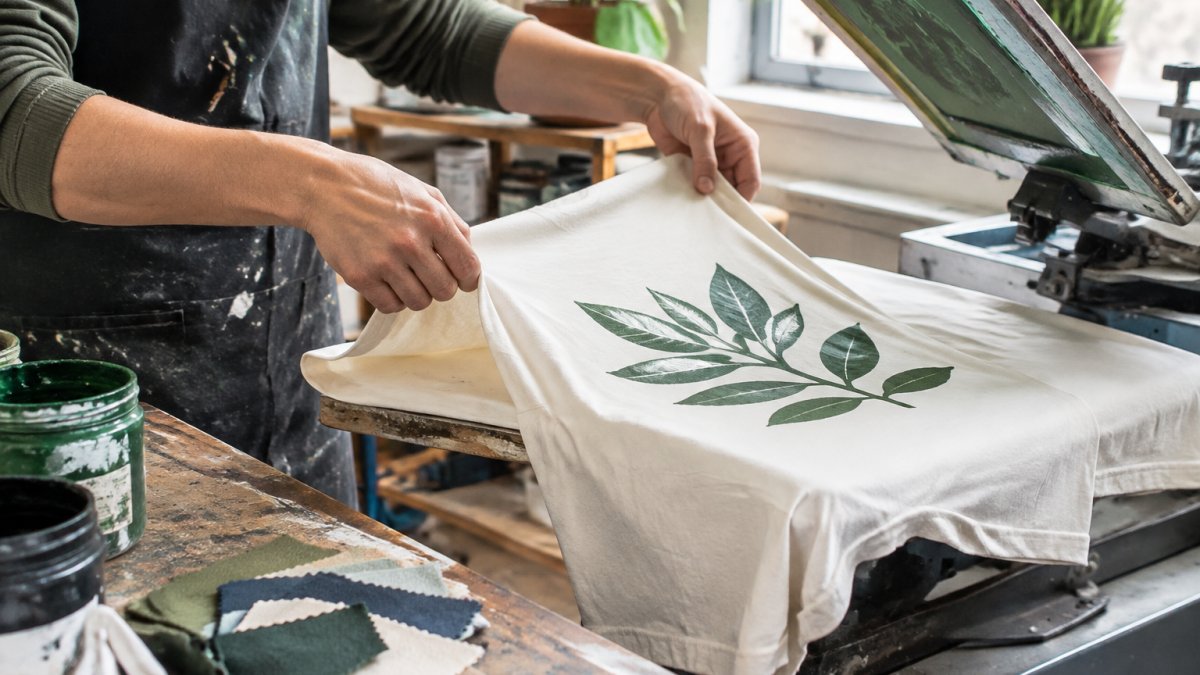
Eco-friendly T-shirt printing survives the wash when the ink chemistry and the curing step are both right, not when the ink is simply labelled water-based.
Matching the decoration to the size of your run
Decoration choice is a numbers decision before it is an aesthetic one. The three methods small teams choose between behave very differently as quantity changes, and each carries its own environmental trade-off.
If you want to see how a finished design looks on a garment before you start, the Manta Ray T-shirt shows the kind of piece the studio produces.
Low minimum order custom apparel for teams of two to twenty
Low minimum order custom apparel exists because print-on-demand changed the economics. Instead of holding stock, a supplier prints each garment when it is ordered, so a team of four can order four shirts without a warehouse involved. RushOrderTees' online design studio describes exactly this model: design online, customise with a logo, order in low quantities.
That model has one honest limitation. Pricing depends on quantity, garment choice and delivery, so please visit The Eco Train's website for current prices or a quote. If you are kitting out a small team and want to see what a single garment looks like before committing, you can view the Team T-shirt as a starting point.
What an itemised small-order quote should show
A transparent quote for a small team order breaks down into five lines, and you should ask for each one separately so you can compare suppliers on the same basis:
Ordering mechanics for a team of two to twenty
Small-team ordering works best when you separate the decision from the transaction.
If you want to see how a finished design looks on a garment before you start, the Manta Ray T-shirt shows the kind of piece the studio produces.
Choosing ethical custom clothing suppliers without the greenwash
Choosing ethical custom clothing suppliers comes down to evidence you can check, not language you can be moved by. Three questions separate a real claim from a marketing one:
- Does the supplier name the fibre percentages, or just say "sustainable"?
- Can they name the certification behind an organic claim?
- Do they state where the garment is printed, not just where it is sold?
- Is the print method named, with the ink type?
- Will they send a sample before a full order?
A supplier who answers two of those five clearly is ahead of most. If you want to see how one supplier states its position, read The Eco Train's ethos and judge the wording yourself.
Sizing, samples and reorders: getting the fit right first time
Getting the fit right first time means ordering one sample in the size you expect to sell most, washing it once, and checking both the fit and the print before you commit. Teams routinely skip this step and then discover that a "medium" varies by several centimetres between garment styles.
Reorders are the other half of the problem. Ask, before you buy, whether the same garment style and colour will still be available in three months. Print-on-demand makes reorders of two or three pieces practical, which matters when a new starter joins. For guidance on picking garments and sizes across a group, there is help choosing the right T-shirt.
Design your team's first organic cotton piece in The Eco Train studio
Your first organic cotton piece starts in an online studio. You choose your design and order in the quantity you need. Our print-on-demand service is built for small teams.
The Eco Train's garments are 100% organic cotton, made to support circular fashion principles. If you want to see how a finished design looks on a garment before you start, the Manta Ray T-shirt shows the kind of piece the studio produces.
We built The Eco Train around 100% organic cotton garments, a print-on-demand model, and a UK-based service with an online design studio. Get started with The Eco Train and order the quantity your team actually needs.
Frequently Asked Questions
What is the most sustainable fabric for custom team clothing?
Organic cotton is the most common choice for sustainable custom apparel because it is grown without synthetic pesticides and is traceable through certified supply chains. Recycled polyester made from rPET has a lower virgin-material footprint but still sheds microplastics when washed. For small teams, organic cotton T-shirts and hoodies usually give the best balance of comfort, durability and verifiable credentials. Check for certification rather than taking a label at face value, and ask whether the garment mixes organic and recycled content, since one claim does not prove the other.
Where can small teams order custom organic cotton T-shirts?
Look for suppliers that combine organic cotton stock with low minimum order custom apparel, so a team of five is not forced into a 50-piece run. Print-on-demand services suit teams that need a handful of pieces or expect to reorder as people join. Ask three things before ordering: the exact fabric composition, the decoration method used for small runs, and whether you can buy a single sample first. The Eco Train runs a UK-based print-on-demand studio where you can design your own piece online.
What printing methods are best for sustainable custom apparel?
For small runs, direct-to-garment printing and water-based screen printing are the usual choices. Water-based inks sit in the fabric rather than on top of it, so the print stays soft and breathes. Direct-to-garment suits short runs and detailed designs with no setup cost per colour. Embroidery works well for logos on polos, hoodies and jackets and tends to outlast printed decoration. Whichever method you pick, wash inside out at a low temperature and avoid tumble drying to keep the print from cracking.
What should I check before choosing an ethical custom clothing supplier?
Ask for the fibre composition in writing, the certification behind any organic claim, and where the garment is manufactured. Confirm the decoration method and how it performs after repeated washing. Get an itemised quote so fabric, printing and delivery are visible separately rather than bundled into one figure. Finally, check the returns and reorder process: a supplier that cannot restock the same garment in three months will leave your team in mismatched kit.
